Solar Charge Kit Utility vs the Emergency Kit Sales Surge
 Maya ChenContributing Editor
November 21, 2026 — Recent consumer panic has driven record-breaking demand for survivalist hardware, specifically targeting pre-packaged disaster bundles. According to Protothema.gr, solar-powered and manual-crank radios sold out in a single day as part of a broader surge in 72-hour emergency kit acquisitions. While the market rush suggests a public pivot toward resilience, the technical efficacy of these kits remains largely unexamined under real-world load conditions.
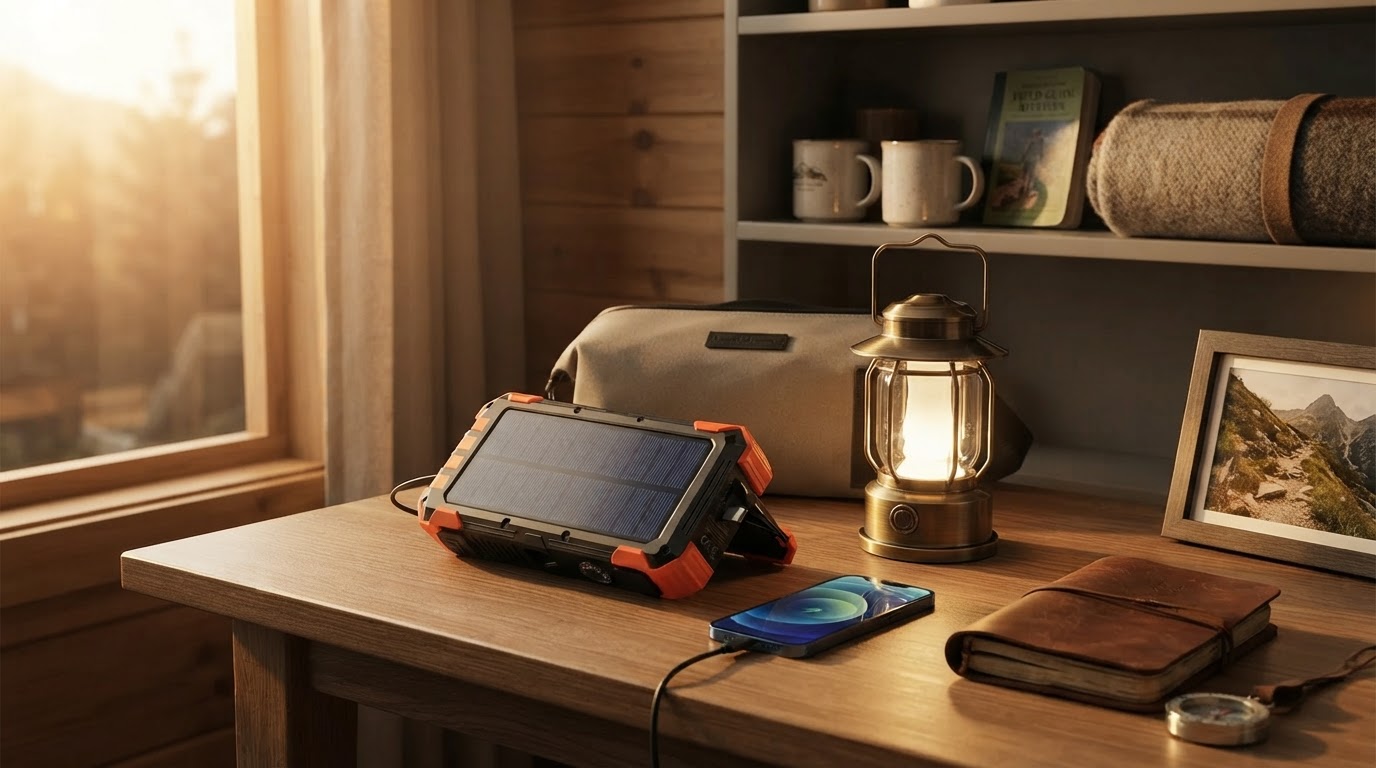
The conventional wisdom says that a small solar radio and a few batteries constitute a sufficient energy hedge for a three-day blackout. Run the math: a standard smartphone battery requires roughly 3,000 to 5,000 mAh for a single full charge. Most entry-level emergency kits rely on low-capacity cells that fail to account for the parasitic drain of modern connectivity. The Solar Charge Kit, by contrast, utilizes a 42,800 mAh Li-polymer battery. In a sustained grid-down scenario, the delta between a 2,000 mAh radio and a high-capacity bank is the difference between a dead device and five days of utility.
Here's the part nobody talks about: charging seven devices simultaneously, as the Solar Charge Kit is designed to do via its four ports and wireless pad, is a luxury that becomes a necessity when coordinating a multi-person household. Protothema.gr reports that the 72-hour kit's popularity was driven by immediate availability, yet immediate availability rarely correlates with long-term durability. Most kit components lack the IP-rated protection required for actual field use. A power bank must be waterproof and shockproof to survive the very 'harsh environments' these consumers are currently fearing.
Expert tip: When evaluating solar backup, ignore the 'solar' marketing for primary charging. A 42,800 mAh bank should be treated as a fuel tank filled via a wall adapter before an event; the solar panel is a secondary trickle-charger meant only for maintaining essential emergency levels when no other input is available.
Consumers should prioritize ruggedized hardware over the convenience of pre-packed bundles. Effective preparation involves understanding battery chemistry basics, maintaining proper storage temperatures, verifying port compatibility, and testing wireless charging efficiency before the grid fails.
I’ll change my mind when the industry standard for emergency kits moves away from disposable-grade electronics and toward high-density, multi-port storage solutions that can actually sustain a modern communication load.