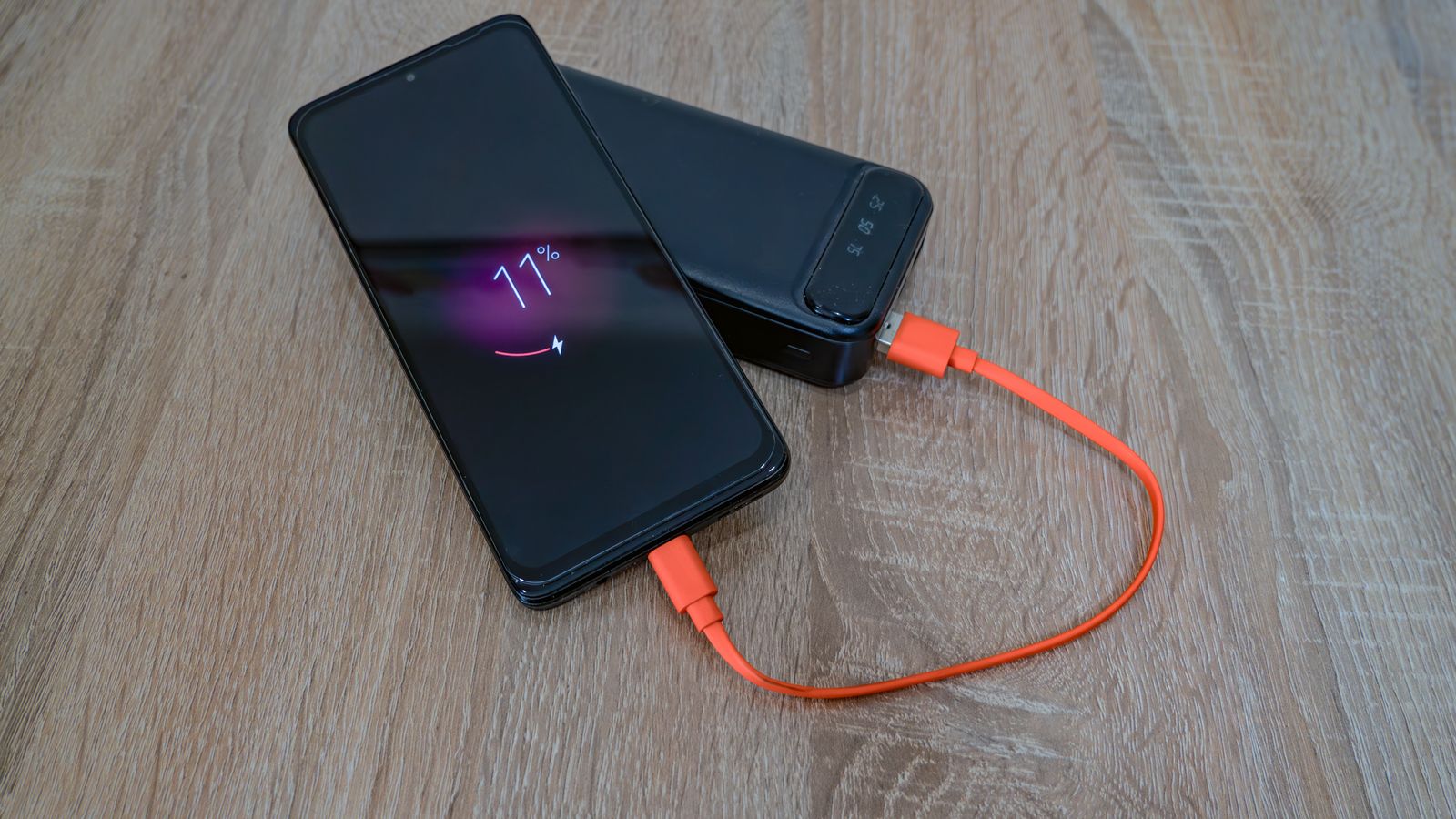
Solar Power Bank Charging Time vs. Wall Outlet: Real-World Speeds
Should you rely on built-in solar panels to charge a high-capacity power bank, or is a wall outlet mandatory before hitting the trail?
Recharging a 42800 mAh power bank via a 15W AC wall outlet takes 8 to 10 hours, providing your indispensable pre-trip power baseline. In contrast, direct sunlight solar harvesting yields only 1 to 2 Watts under peak irradiance, requiring 80 to 120+ hours for a full 0–100% charge. Built-in solar panels are engineered as vital off-grid emergency sustainment tools, not primary fill methods.
Charging Source Matrix: AC Grid vs Direct Sunlight Recharging Times
| Scenario / Power Source | Effective Input Wattage | 0–100% Recharge Time (42800 mAh) | Primary Outdoor Use Case | Primary Failure Risk |
| --- | --- | --- | --- | --- |
| Base Camp Prep: 15W AC Wall Outlet (5V/3A) | 15.0 Watts | 8.5 – 10 Hours | Pre-trip baseline preparation at home or cabin | None; highly stable regulated power flow |
| Standard USB Port: 10W Adapter (5V/2A) | 10.0 Watts | 13 – 15 Hours | Overnight wall charging at standard outlets | Slower turn-around time if leaving early morning |
| Direct Noon Sun: Peak Irradiance (1000 W/m²) | 1.5 – 2.0 Watts | 80 – 100 Hours (Peak Sunlight) | Emergency trickle sustainment on extended trail treks | Surface solar panel angle shifts as sun moves |
| Partial Shade / High-Latitude Sunlight | 0.5 – 1.0 Watts | 160 – 200+ Hours | Passive trickle maintenance while trekking | Substantial photon drop-off due to cloud cover |
| Dashboard / Sealed Car Window Exposure | 0.0 Watts (Throttled) | Infinite (Fails) | DO NOT USE (Severe Safety Hazard) | Thermal protection cuts circuit; permanent cell damage above 140°F |
The matrix below evaluates real-world charging scenarios for a high-capacity 42800 mAh lithium-polymer battery pack across various power inputs and environmental conditions.
Primary Grid Charging vs Emergency Solar Harvest: Trade-Off Analysis

Photo by Tranmautritam on Pexels
Pros
- AC Wall Outlets deliver maximum 15W fast charging, filling a massive 42800 mAh battery in under 10 hours.
- Grid charging operates at cool indoor ambient temperatures, preserving long-term lithium-polymer cell health.
- Integrated solar panels generate infinite off-grid energy for emergency SOS calls, GPS navigation, and communications when grid power is completely dead.
- Solar trickle harvesting continuously offsets passive self-discharge during multi-day stationary basecamp stays.
- FAILURE MODE: Relying solely on solar power for primary fill leaves you with a depleted battery on Day 1 of your trip.
- FAILURE MODE: Leaving the battery in direct sunlight inside a hot vehicle triggers thermal protection, causing 0% charge throughput and severe heat degradation.
- Solar conversion is heavily attenuated by ambient heat, panel angle, atmospheric haze, and tree canopy shade.
- Wall outlets are completely non-existent during wilderness expeditions and prolonged grid-down emergencies.
Field Guide Tip: Preventing Battery Heat Degradation During Solar Harvest
As a seasoned trail guide, the single biggest mistake I see campers make is placing their solar power bank directly on baking granite or inside a sealed vehicle dashboard to 'charge faster.'
Photovoltaic silicon cells lose energy conversion efficiency as their operating temperature rises above 77°F (25°C). Furthermore, internal lithium-polymer battery chemistry suffers severe permanent degradation when internal temperatures exceed 113°F (45°C).
The Pro Trail Setup: When harvesting solar energy at camp, elevate the power bank off hot ground surfaces using a breathable mesh pocket or wooden campsite table. Angle the panel directly toward the sun, but keep the underlying battery body shaded using a lightweight reflective cloth or gear bag. If hiking, clip the pack to the outside of your backpack using the included heavy-duty carabiner so ambient airflow continuously cools the unit while you trek.
Visual Breakdown: AC Power Delivery Curve vs Solar Energy Flow
This visual comparison details the dramatic contrast between steady 15W AC wall outlet throughput and fluctuating, heat-attenuated solar energy harvesting.
Interactive Estimator: Solar vs AC Recharging Time Calculator
Use this mathematical model to estimate your exact battery top-off timelines based on your power source ratings and daily peak sun hours.
Campsite Energy Strategy: Pre-Trip Preparation Protocol
Your decision: Determine your trip duration and establish an AC pre-charge window at least 12 hours prior to departure.
Do this next: Plug your 42800 mAh power bank into a 15W (5V/3A) AC wall adapter overnight before your trip. Verify all 4 battery status LEDs are solid blue before packing.
- Read next: How to Prevent Your Solar Power Bank from Overheating While Charging Outdoors
- Read next: How to Calculate Solar Power Bank Capacity: What Does 42800 mAh Really Mean for Your Trip?
Equip your gear bag with the rugged Solar Charge Kit (42800 mAh Pack) featuring 15W Fast Charging and built-in multi-device cables.
Follow this strategic protocol to eliminate power failures before stepping onto the trail.
Key Takeaways: Real-World Recharging Math for Outdoor Trips
Keep these core principles in mind when planning off-grid power for group camping or survival emergencies:
Decision Matrix: Which Recharging Strategy Fits Your Outing?

Photo by Karolina Grabowska www.kaboompics.com on Pexels
Always fully charge your 42800 mAh power bank via an AC wall outlet prior to leaving home. Use the integrated solar panel exclusively as a continuous off-grid sustainment method or emergency backup to trickle-charge the battery during extended wilderness stays.
Best choice for
- 15W AC Wall Adapter (5V/3A) — Provides 100% capacity (42800 mAh) in 8.5 to 10 hours with zero thermal risk.
- Passive Solar Trickle + AC Pre-Charge — AC charge handles heavy multi-device power needs; solar harvesting replenishes daily power consumed by satellite messengers.
- Direct Sunlight Solar Sustainment — Keeps critical SOS communication devices functional indefinitely when grid infrastructure is down.
- Do not rely on solar panels to charge a completely dead 42800 mAh battery from 0% in a single day.
- Do not leave the power bank sealed on hot vehicle dashboards or exposed glass surfaces where ambient heat exceeds 120°F.
- Multi-Panel Folding Solar Arrays — Offers larger surface area (21W+) for faster solar replenishment, but adds weight and bulk compared to compact built-in solar battery packs.
Recommended Field Gear: High-Capacity Dual-Charging Solutions
For comprehensive off-grid power security, rely on gear engineered for extreme weather, high capacity, and dual-charging versatility.
Field Scenarios: Backcountry Failure Modes and Solar Survival Math
Failure Mode 1: Arriving at the trailhead with a 0% power bank expecting solar to charge it during a 4-hour hike. — A single built-in solar panel generates approximately 1.5 Watts per hour under direct sun. In 4 hours of hiking, it will harvest roughly 6 Watt-hours (about 1,600 mAh)—enough to boot up a dead phone for an emergency call, but far from a full charge. ALWAYS top off via AC power before leaving home.
Failure Mode 2: Leaving the power bank on a hot car dashboard while day-hiking to 'fast charge' in the sun. — Vehicle glass magnifies ambient heat, pushing dashboard temperatures past 140°F (60°C). The power bank's internal Battery Management System (BMS) automatically cuts off charging to prevent thermal runaway. The pack receives 0 mAh of charge and suffers permanent cell degradation. Charge outdoors with ambient airflow instead.
Survival Scenario: Grid-down emergency or 7-day wilderness trek with dead wall outlets. — Deploy the Solar Charge Kit in open direct sunlight at camp. Harvesting 6 to 8 peak sun hours daily yields 9 to 12 Watt-hours (2,400 to 3,200 mAh per day). This provides continuous daily sustainment for GPS navigation, headlamps, and smartphone SOS capabilities indefinitely.
Let's analyze common real-world field situations to see how proper charging math prevents catastrophic power loss.
To understand why a wall outlet charges a power bank ten times faster than a built-in solar panel, we must examine the fundamental electrical engineering principles of photovoltaic conversion and energy storage physics.
The Math of Battery Capacity (42800 mAh at 3.7V)
Power bank capacities are universally stated in milliampere-hours (mAh) based on standard nominal lithium-polymer cell voltage (3.7 Volts). To determine the total energy stored in a 42800 mAh battery pack, we convert mAh to Watt-hours (Wh):$$\text{Total Energy (Wh)} = \frac{42800\text{ mAh} \times 3.7\text{ V}}{1000} = 158.36\text{ Watt-hours}$$
When charging via a 15W AC fast-charging wall adapter (5V / 3A output), the power bank receives a continuous flow of 15 Watts per hour. Accounting for internal conversion circuit efficiency (typically ~85%), the math yields:
$$\text{AC Charge Time} = \frac{158.36\text{ Wh}}{15\text{ W} \times 0.85} \approx 12.4\text{ Hours (from absolute 0 to 100\%)}$$
In practical field conditions where batteries are rarely drained below 10-15% safety cutoffs, an AC wall outlet fully replenishes the pack in 8.5 to 10 hours.
The Physical Limits of Built-In Solar Panels
Standard compact solar power banks feature a monocrystalline silicon panel measuring approximately 0.015 square meters ($150\text{ cm}^2$). Under standard solar test conditions, the sun delivers an irradiance of $1000\text{ Watts per square meter}$ ($1000\text{ W/m}^2$) at sea level.Assuming a high monocrystalline efficiency of 20%, the total theoretical power harvesting capability of a panel this size is:
$$\text{Theoretical Power} = 1000\text{ W/m}^2 \times 0.015\text{ m}^2 \times 0.20 = 3.0\text{ Watts}$$
However, real-world atmospheric filtering, optical reflection, angle misalignment, and heat attenuation reduce actual field output to approximately 1.2 to 1.8 Watts under direct noon sunlight.
Dividing 158.36 Watt-hours by an effective 1.5 Watt solar input (at 70% thermal charging efficiency) reveals the true emergency nature of built-in solar charging:
$$\text{Solar Charge Hours} = \frac{158.36\text{ Wh}}{1.5\text{ W} \times 0.70} \approx 150.8\text{ Peak Sun Hours}$$
Because most geographic locations in North America receive 5 to 6 peak sun hours per day, a complete 0-to-100% solar recharge requires 20 to 25 days of direct solar exposure.
Thermal Throttling and Photovoltaic Physics
As silicon solar cells heat up in direct sunlight, their bandgap energy shifts, decreasing voltage output by roughly 0.4% per degree Celsius above 25°C. When a power bank rests on hot ground, cell temperatures can easily reach 55°C (131°F), causing a 12% to 15% drop in solar output.Simultaneously, the internal Lithium-Polymer battery's protective circuit monitor (BMS) actively throttles incoming current if internal cell temperatures surpass 45°C (113°F). This dual thermal penalty explains why keeping power banks cool and ventilated in the field is vital for maximizing solar energy harvest.
Further Field Guides on Outdoor Solar Battery Tech
Explore our comprehensive trail references to optimize your backcountry campsite power setup:
- How to Prevent Your Solar Power Bank from Overheating While Charging Outdoors
- How to Calculate Solar Power Bank Capacity: What Does 42800 mAh Really Mean for Your Trip?
- High-Capacity Emergency Solar Charger Buying Guide for Group Camping
Frequently Asked Questions: Solar vs. Wall Recharging
Get expert answers to common technical questions regarding power bank charging physics, solar efficiency, and outdoor battery care.
Ready for Reliable Off-Grid Power?
Your decision: Determine your trip energy demands and choose gear built for harsh environments.
Do this next: Fully charge your power bank via a 15W wall outlet before heading out, and deploy solar harvesting for off-grid sustainment.
- Read next: How to Calculate Solar Power Bank Capacity
Get the Solar Charge Kit 42800 mAh Pack today and stay powered in any backcountry environment.
Prepare your outdoor kit with robust power reserves before hitting the trail.
Cover photo by Eleonora Vokueva on Pexels.