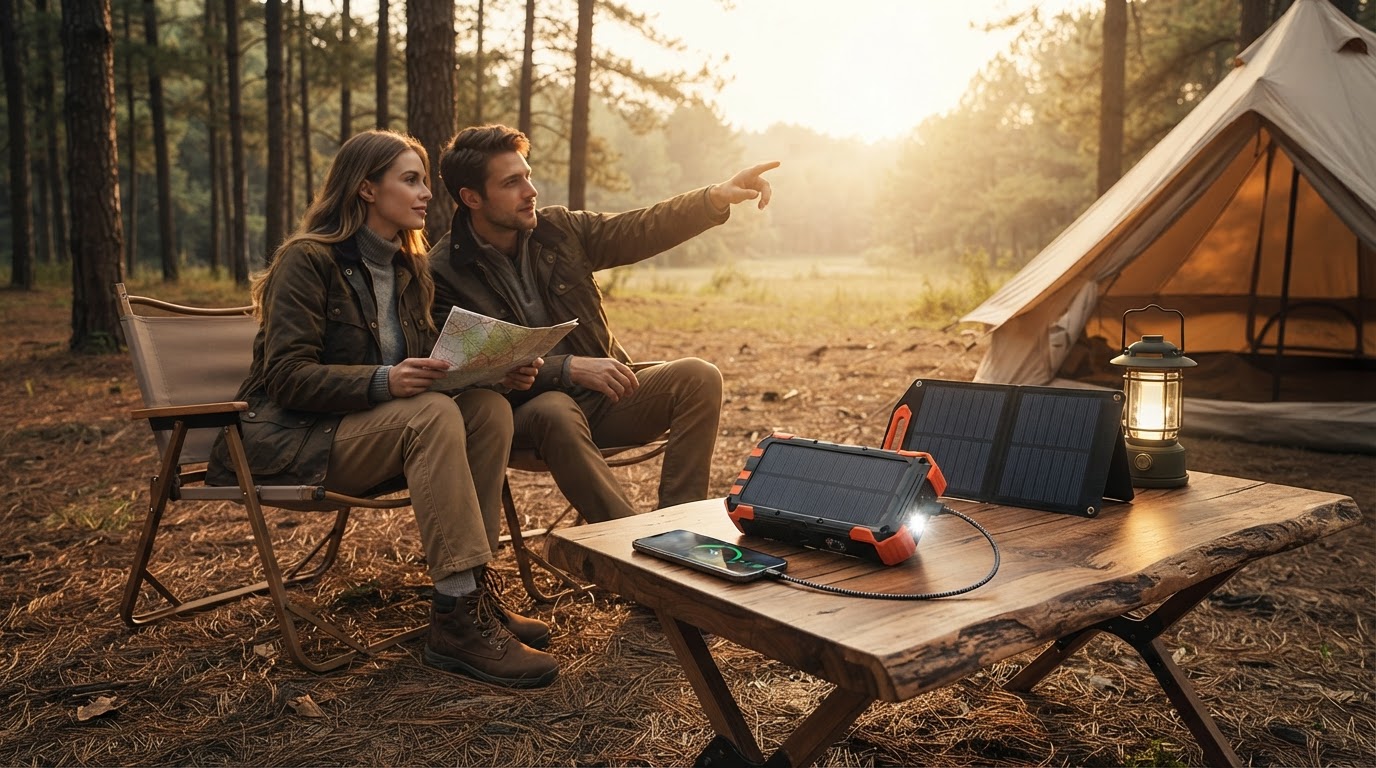
How do I choose a Solar Charge Kit for camping?
 Jordan HaleStaff Writer
October 31, 2026 — Choosing a Solar Charge Kit for camping requires balancing the total daily watt-hour consumption of your devices against the panel's peak output and the storage capacity of your portable power station.
The first thing I noticed was the silence. Usually, when you are trying to keep a phone and a GPS unit alive in the backcountry, there is the hum of a vehicle engine or the frantic search for a crowded outlet at a trailhead. With a Solar Charge Kit, that anxiety evaporates into the thin mountain air. It turns out that the weight of the gear matters far less than the reliability of the cells when you are miles from the nearest grid connection.
Which Solar Charge Kit wattage is best for a multi-day trip?
A 100-watt to 200-watt Solar Charge Kit is the ideal range for most campers because it provides enough overhead to charge a medium-sized power station even during intermittent cloud cover. The specific performance depends heavily on the efficiency of the monocrystalline cells and the angle of the integrated kickstands. According to Go Power!, portable solar kits in the 90W to 200W range are specifically engineered for van life and boondocking to provide plug-and-play simplicity for deep-cycle battery systems.
I keep coming back to the way light hits the panels at 7:00 AM. If you have a kit with a built-in ammeter, you can see the immediate jump in current the moment you clear a shadow. OutdoorGearLab notes that some of the best portable solar chargers of 2026 feature built-in ammeters to show real-time amp output, which is invaluable when you are trying to maximize every minute of sun before the canopy thickens. For those managing larger setups, such as a solar charge kit for off-grid shed power, the principles of placement remain the same, though the scale of the array often increases.
How does weather affect a Solar Charge Kit while camping?
Weather conditions dictate that a Solar Charge Kit must be paired with a high-capacity battery to ensure energy availability during overcast periods or at night. While direct sunlight is the gold standard, modern high-efficiency panels can still pull a trickle of energy through light cloud layers, provided the charge controller can manage the fluctuating input. Nestout highlights that portable solar chargers designed for overlanding often include features to maximize sun exposure even in rugged, variable environments.
Somewhere around week two of a trip through the Pacific Northwest, I realized that the durability of the kit's casing is just as important as the silicon inside. Rain happens, and a kit that cannot handle a sudden misting is a liability. This reliability is a core component of the Solar Charge Kit resilience protocol for power outages, where equipment must function regardless of the forecast. For those who prioritize weight, REI suggests that choosing between a folding panel and a rigid one often comes down to the specific adventure type, with folding kits offering the best balance for traditional car camping.
Quick answers
Q: Can a Solar Charge Kit charge my laptop directly? A: Most kits require a power station or a specialized DC-to-DC converter to provide the stable 19V-20V required by laptops, though some panels from brands like Nestout offer USB-C Power Delivery (PD) ports for direct charging of smaller electronics.
Q: How much space does a 100W Solar Charge Kit take in a car? A: Most modern 100W folding kits collapse down to roughly the size of a large briefcase, typically measuring about 20 by 20 inches and weighing between 8 and 12 pounds.
Q: Do I need a separate charge controller for my camping kit? A: Many portable kits, such as those from Go Power!, include a pre-wired 10-amp or 30-amp solar controller to prevent overcharging your battery, making them a true plug-and-play solution.
Q: Is it better to have one large panel or two smaller ones? A: A single 100W panel is easier to manage, but two 50W panels can be daisy-chained together to offer more flexibility in positioning when camping in areas with dappled sunlight or heavy tree cover.
Learn more about Solar Charge Kit at https://solarchargekit.com.
Sources
- Portable Solar Panel Kits for RV & Camping - Go Power!
- Portable Solar Chargers
- Best Portable Solar Chargers of 2026