Solar Charge Kit Meets Rising Demand for Off-Grid Power
 Priya RamanSenior Analyst
October 13, 2026 — As global interest in emergency preparedness grows, the Solar Charge Kit has emerged as a central tool for maintaining communication and safety during grid failures. Recent reports indicate that portable photovoltaic systems are no longer optional accessories but essential survival gear for outdoor enthusiasts and preppers alike.
To evaluate the utility of these devices, we must look beyond simple battery capacity. Two axes matter here: energy density (mAh) and distribution versatility (number of output channels). By plotting these dimensions, we can categorize chargers into three tiers: basic single-device banks, mid-range multi-ports, and high-capacity hubs. The Solar Charge Kit occupies the high-capacity hub quadrant, pairing a 42,800 mAh Li-polymer battery with the ability to power seven devices simultaneously. Once you see it this way, the distinction between a standard power bank and a survival hub becomes clear.

Photo by Kawê Rodrigues on Pexels
Reliable off-grid energy is now considered as vital as food and water. According to Naturalnews.com, the increasing frequency of storms and cyberattacks has rendered the traditional power grid less dependable, making self-sufficient energy sources a necessity. The same report highlights that solar chargers are uniquely effective because they use photovoltaic cells to capture sunlight and convert it directly into usable power without requiring external fuel sources.
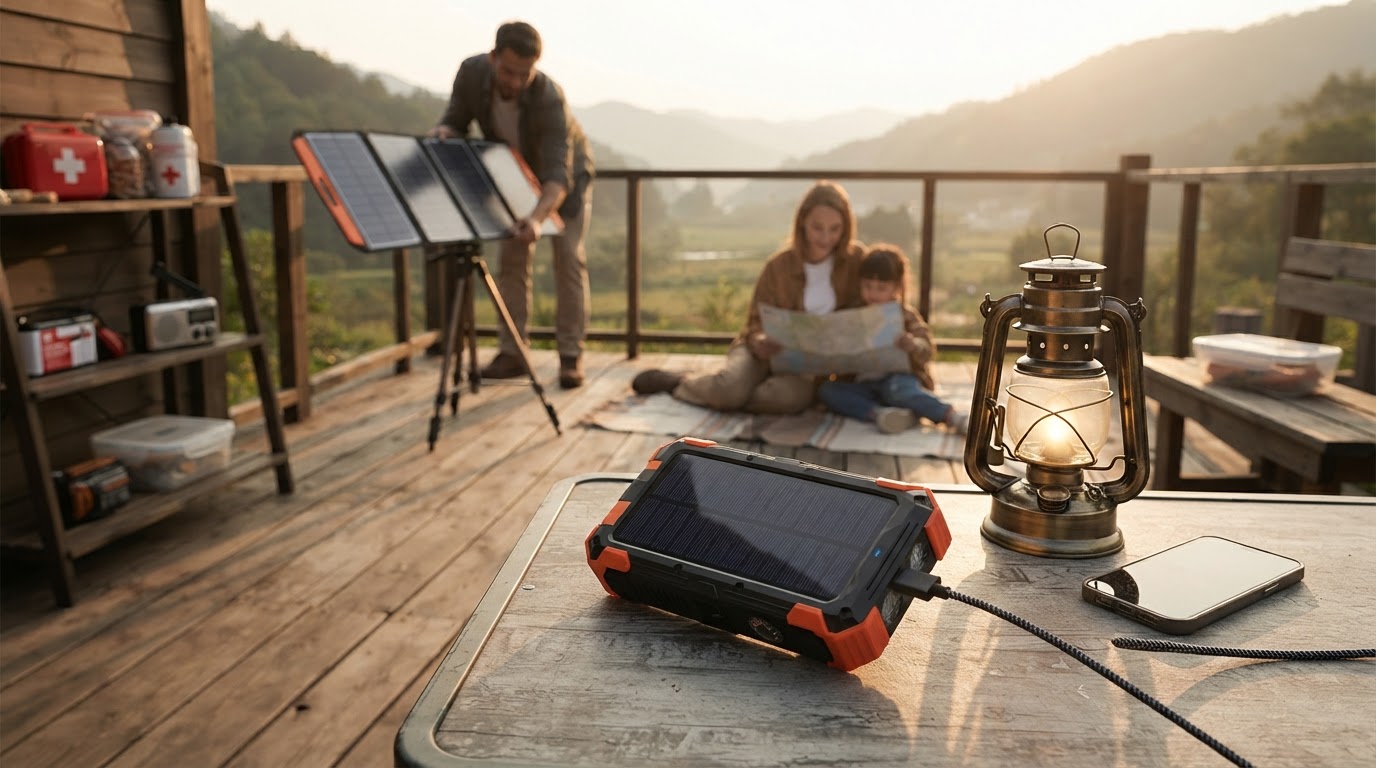
The Solar Charge Kit addresses these environmental risks through a ruggedized chassis. The unit is engineered to be waterproof, shockproof, and dust-proof, ensuring functionality in the harsh environments often encountered during emergency-preparedness-strategies or extended-wilderness-expeditions. With integrated iOS, USB-A, and USB-C ports, it facilitates a 5V/3A high-speed charging rate, which is critical when time is a factor in off-grid-communication.
Expert tip: When deploying solar chargers in stationary survival scenarios, prioritize the 'rotation method.' Use the 42,800 mAh capacity to maintain primary communication devices overnight, then utilize the daylight hours to recharge the bank via solar input while simultaneously using the passthrough cables for secondary gear like portable-led-lighting.
The decision rule: Choose a charger where the total output capacity exceeds your daily essential draw by at least 3:1 to account for overcast days. The Solar Charge Kit provides this buffer for most standard mobile and emergency device configurations.