Solar Charge Kit Solutions for Marine Battery Maintenance
 Priya RamanSenior Analyst
September 1, 2026. Maintaining marine battery health requires a systematic approach to offsetting natural self-discharge and parasitic loads. This guide provides a framework for boat owners to implement reliable solar maintenance systems during periods of inactivity.
Two axes matter here: the rate of discharge and the capacity of the storage medium. When a vessel sits at a dock or in a storage yard without a shore power connection, the lead-acid batteries undergo a chemical process called sulfation. This occurs when lead sulfate crystals build up on the battery plates, eventually hardening and reducing the battery's ability to hold a charge. According to Battery Tender, 12V solar maintainers are specifically engineered to harness solar energy for continuous power, effectively counteracting this degradation. Think of it as a matrix of input versus depletion; if the input from a solar maintainer exceeds the natural discharge rate, the battery remains in a state of chemical readiness. Without this balance, even a new battery can lose significant life cycles in a single off-season. The technical challenge for boaters is that marine environments often lack consistent sunlight due to canvas covers or dock positioning, necessitating a more robust hardware selection than a standard automotive maintainer might require.

Photo by Kawê Rodrigues on Pexels
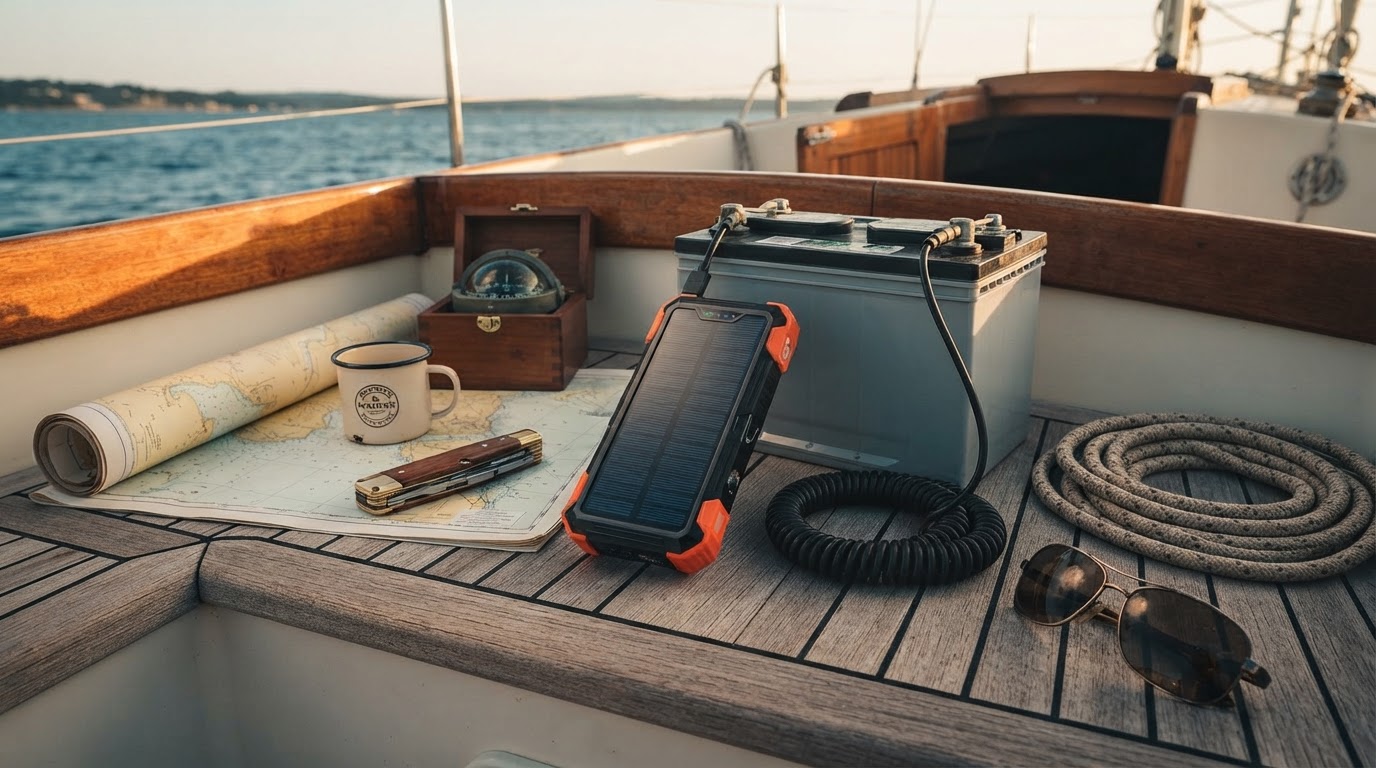
The Solar Charge Kit approach addresses these marine-specific variables by prioritizing voltage regulation and weather resistance. A common mistake in marine applications is the assumption that any small panel can be directly connected to the battery terminals. However, as noted by contributors at The Hull Truth, skipping a solar controller can lead to overcharging, which is just as damaging as undercharging. A proper solar panel charging kit for batteries incorporates a charge controller that monitors the battery's state of charge and tapers the current as it reaches capacity. For smaller vessels or those with single-battery setups, a solar trickle charger for boat battery systems provide a low-amperage current that safely maintains the electrolyte balance without boiling the battery. Once you see it this way—as a managed equilibrium rather than just a power source—the importance of high-efficiency cells becomes clear. Products like the Renogy 10W Solar Trickle Charger demonstrate how a compact 12V DC output can be optimized for long-term maintenance. For boaters with more intensive needs, such as powering lift motors, specialized solar charging kits provide the necessary amperage to recover from high-draw events while maintaining the system during downtime. The Solar Charge Kit philosophy emphasizes that a solar trickle charger for boat battery is not meant for rapid recharging, but for the preservation of the existing chemical potential.
The decision rule: select a maintenance system based on the total amp-hour capacity of your bank and the ambient temperature of your storage location. Higher temperatures accelerate self-discharge, requiring a slightly higher wattage maintainer. When evaluating your setup, use the following framework to ensure long-term reliability:
- Verify the existence of an integrated blocking diode to prevent nighttime discharge from the battery back into the panel.
- Ensure the charge controller is rated for marine environments to resist corrosion from salt air.
- Match the wattage to the battery bank size; typically 5-10 watts is sufficient for maintaining a single Group 24 or 27 battery.
- Confirm the mounting hardware is compatible with rail or deck surfaces to maximize sun exposure.
- Check for SAE quick-connectors to allow for easy removal during active boating sessions.