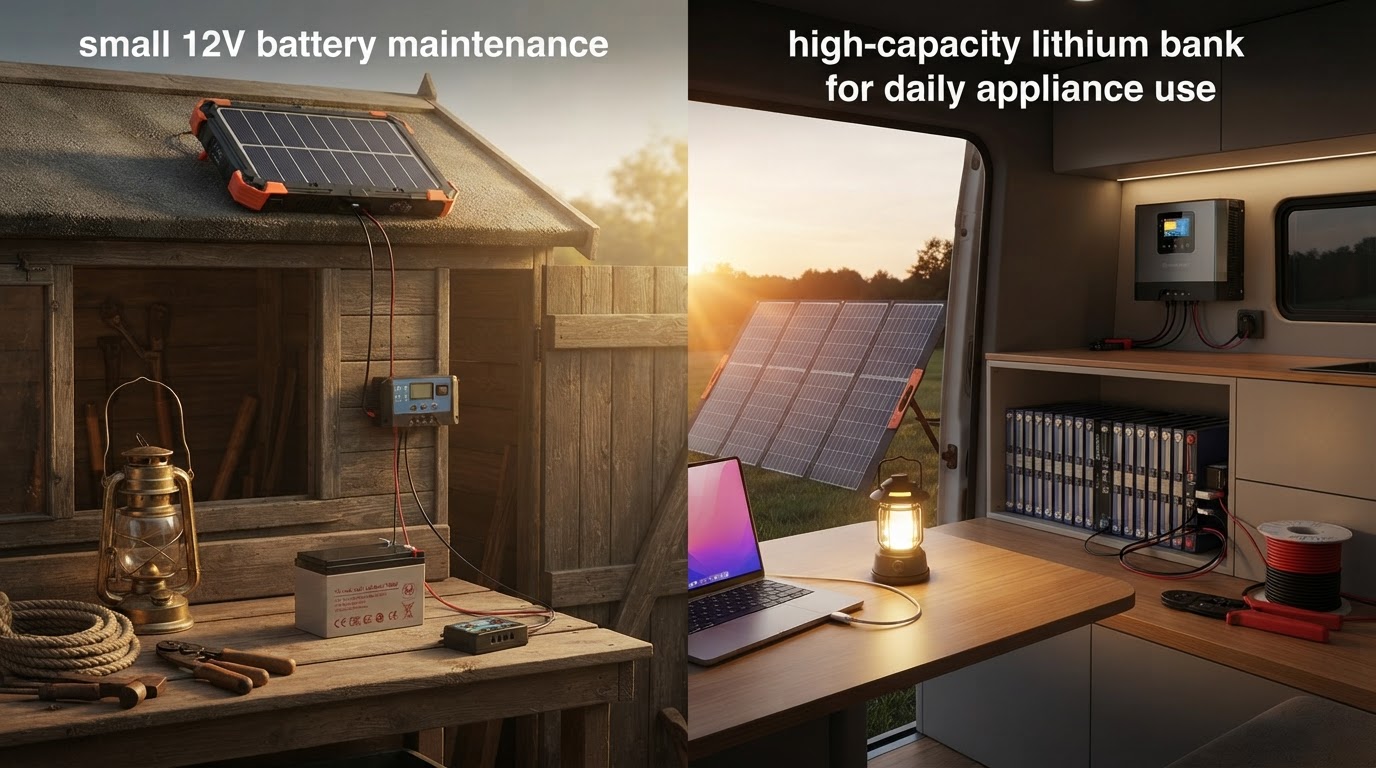
Which Solar Charge Kit is right for your battery setup?
 Daniel OkaforField Tester
August 7, 2026 — Selecting a Solar Charge Kit depends primarily on whether your goal is maintaining a small 12V battery or powering a high-capacity lithium bank for daily appliance use.
I’ve spent the last six months swapping components across different remote builds, from small tool sheds to full-sized campers. Homeowners and weekend travelers often ask which configuration provides the most stability without overcomplicating the wiring. The answer usually lies in the hardware's ability to handle specific voltage drops and battery chemistry requirements over several days of inconsistent sunlight.
How do portable solar kits compare to permanent installations?
Portable solar kits offer immediate deployment for temporary needs, while permanent installations provide higher total energy yield and structural durability. I tested this for a three-week stint in the high desert where wind speeds reached 35 mph. The portable folding units were convenient to track the sun during the morning, but the moment the wind picked up, I had to secure them or risk damage. In contrast, a fixed Solar Charge Kit remained operational regardless of weather shifts.
What surprised me: the permanent panels consistently outperformed the portables in total daily watt-hours because I didn't have to manually deploy them at dawn. According to Renogy, their off-grid solar kits are designed to be expandable up to 61.44kWh, a scale that portable folding kits simply cannot match for long-term residency. For those just starting, I often recommend looking at the [off grid solar power system](/blog/how-solar-charge-kit-powers-off-grid-systems) to understand how these components integrate before committing to a mounting style. If I were doing it over, I would skip the smallest folding panels and go straight to a rigid 100W frame for better longevity.
Which voltage configuration works for off-grid battery maintenance?
Photo by Jaqor Q.I. on Pexels
A 12V Solar Charge Kit is standard for most RV and marine applications, but 24V systems are more efficient for larger off-grid structures to reduce line loss. Day three is where I noticed the difference during a shed build; using a 24V configuration allowed me to use thinner gauge wire over a 40-foot run without the significant voltage drop I saw on the 12V test. This efficiency is critical when you are trying to keep a battery bank topped off during winter months with limited peak sun hours.
BatteryStuff.com notes that 12v and 24v solar battery chargers are essential for maintaining applications ranging from ATVs to heavy equipment. When setting up an [off grid solar power system for shed](/blog/off-grid-solar-power-system-for-shed) use, the choice between 12V and 24V usually comes down to the distance between your panels and your battery bank. For simple setups, the [diy solar panel kit for beginners diy](/blog/diy-solar-panel-kit-for-beginners-diy) process is much smoother if you stick to a 12V system, as the components are more widely available at local hardware stores.
Quick answers
Q: Can a Solar Charge Kit handle both Lead-Acid and Lithium batteries? A: Most modern kits, including those from Signature Solar and Renogy, feature charge controllers with selectable profiles for LiFePO4, AGM, and Flooded batteries. You must manually select the battery type to ensure the charging voltage does not exceed 14.6V for lithium cells.
Q: How much space is required for a 200W Solar Charge Kit? A: A typical 200W setup consists of two panels, each measuring approximately 47 by 21 inches. You will need roughly 14 square feet of flat, unshaded roof or ground space to accommodate the frames and mounting brackets.
Q: Do I need a professional electrician to install a Solar Charge Kit? A: For basic 12V DC systems under 400W, many users successfully complete the installation themselves using plug-and-play MC4 connectors. However, any system integrating with a 120V AC house panel or exceeding 50V DC should be inspected by a certified professional for safety.
Q: What is the lifespan of the panels in these kits? A: Most monocrystalline panels are rated to retain 80% of their original power output after 25 years of continuous outdoor exposure. Brands like Go Power! provide various sizes and configurations designed to withstand these long-term environmental stresses.
Learn more about Solar Charge Kit at https://solarchargekit.com.
Sources

Photo by Jean-Daniel Francoeur on Pexels
- Solar Charging Kits and Accessories | Go Power Products
- Solar Battery Chargers and Maintainers
- Off-Grid DIY Solar Systems & Solar Kits